Shopify vs Magento in 2026: Which Platform Fits Your Business?
4 min read
Shopify vs Magento is one of the questions we hear most from growing brands. Both platforms power large, successful stores. However, they suit very different businesses, budgets and teams.
So here is a clear 2026 comparison of cost, control, upkeep and growth. It comes from a team that builds on both platforms every week.
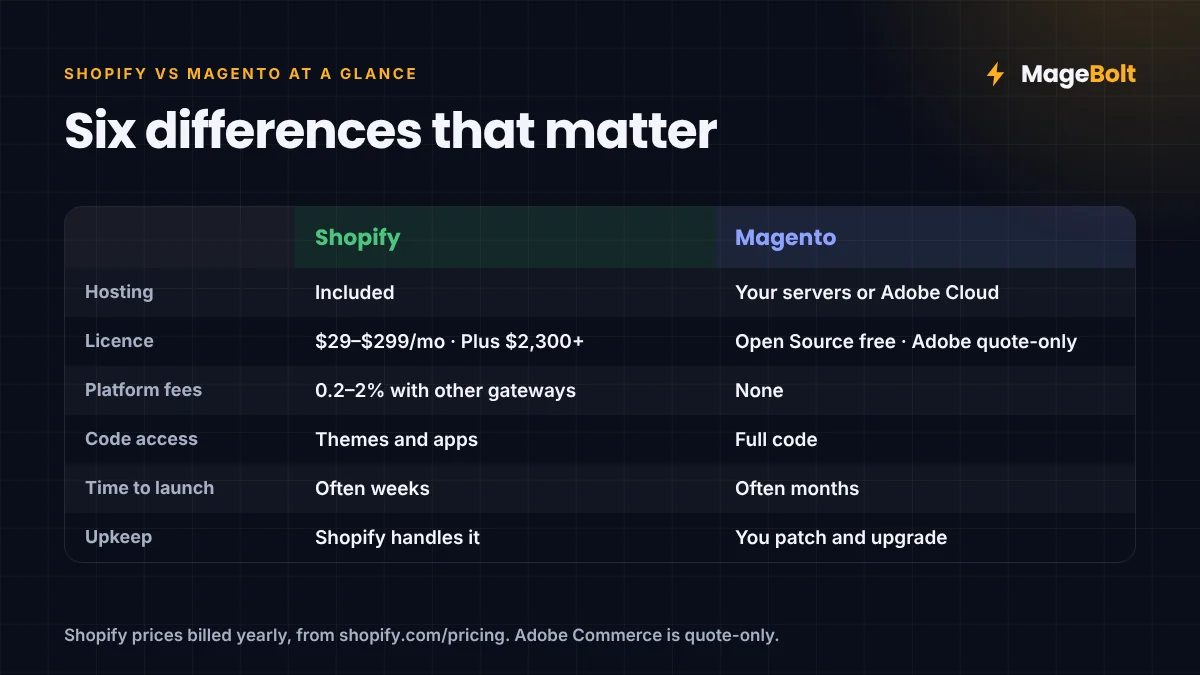
Shopify vs Magento at a glance
To start, Shopify is a hosted service. Then you pay a monthly fee, and Shopify runs the servers, security and updates. By contrast, Magento is software you host yourself, or run on Adobe Commerce Cloud.
| Shopify | Magento | |
|---|---|---|
| Hosting | Included | Your own servers, or Adobe Commerce Cloud |
| Licence | $29–$299 a month on yearly billing; Plus from $2,300 a month | Open Source is free; Adobe Commerce is quote-only |
| Platform transaction fees | 0.2%–2% with third-party payment providers | None |
| Code access | Themes, apps and limited checkout changes | Full access to all code |
| Time to launch | Often weeks | Often months |
| Upkeep | Shopify handles updates | You handle upgrades and patches |
These prices come from Shopify’s pricing page. Note that the platform waives its transaction fee when you use Shopify Payments.
Shopify vs Magento costs: look beyond the monthly fee
At first glance, Shopify looks cheaper and Magento looks free. However, in practice, total cost depends on what you add on top.
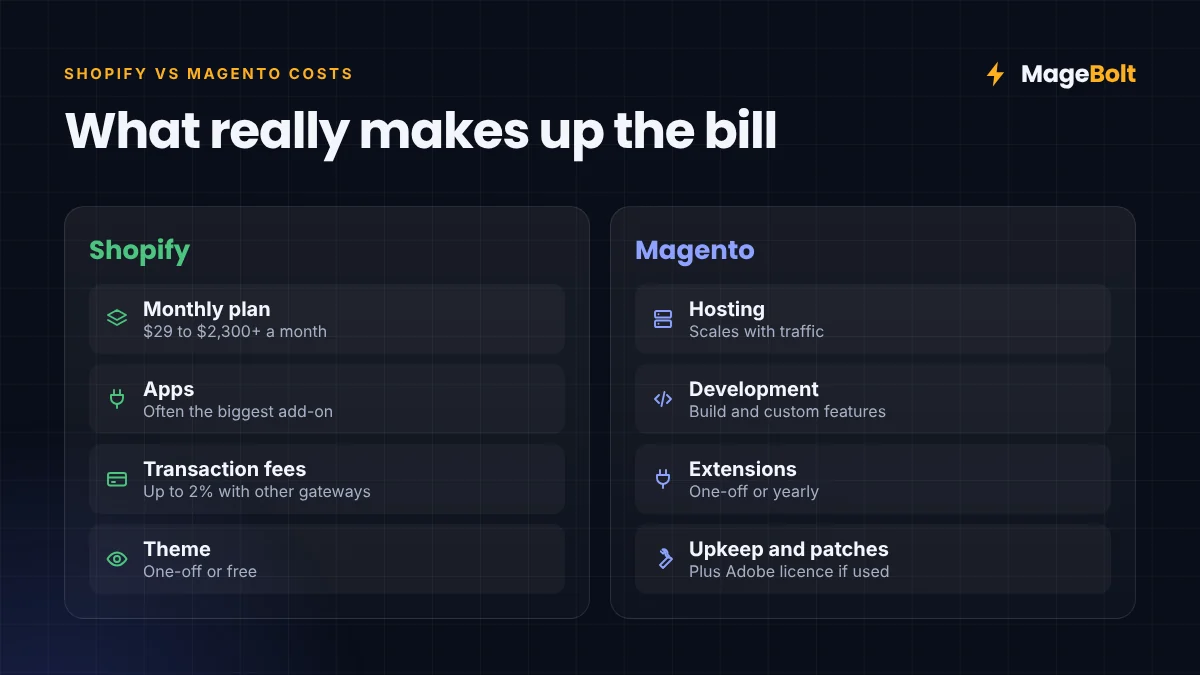
On Shopify, apps often add a large share of the bill. For example, reviews, subscriptions, filters and loyalty tools usually charge monthly. In addition, if you use another payment provider, Shopify adds a fee of up to 2% per order.
Meanwhile, with Magento Open Source, the software itself is free. Still, you also pay for hosting, development, extensions and ongoing upkeep. One industry estimate puts that between $5,000 and more than $90,000 a year (MGT Commerce).
Adobe Commerce, on the other hand, adds a licence on top. Adobe does not publish prices, and agency estimates start at around $22,000 a year for smaller on-premise stores. Since these are only estimates, always ask Adobe for a real quote.
Shopify vs Magento: control and customisation
First, Magento gives you full control. As a result, you can change any part of the store, including checkout, pricing rules and integrations. It also handles multiple stores, languages and currencies from one admin, which suits brands selling in the UAE and beyond.
Shopify, however, gives you less control, but more guard rails. Instead of editing core code, you extend the store with apps, themes and Shopify’s own tools. For most brands, that is therefore enough. However, complex B2B pricing or unusual checkout flows can push against its limits.
That said, apps carry risk on both platforms. For instance, our post on the Shopify checkout hijack shows how third-party code can reach your checkout.
Speed, security and upkeep
On one side, Shopify handles hosting, scaling and security patches for you. So your team can focus on selling.
With Magento, by contrast, your team or agency owns that work. In other words, you must apply security patches and plan upgrades. Our Magento 2.4.9 upgrade guide shows what that involves this year. On the plus side, you can then tune every layer for speed.
Which platform should you choose?
There is no single winner in the Shopify vs Magento debate. Instead, match the platform to your business.
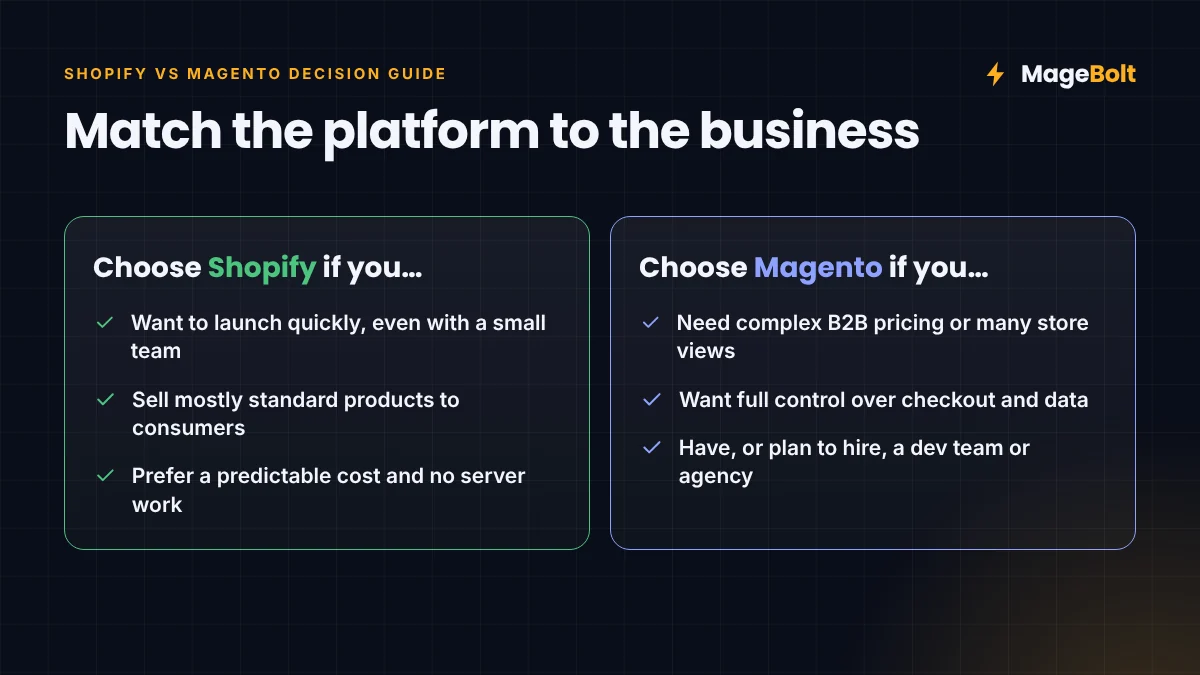
Choose Shopify if you:
- Want to launch quickly, even with a small team.
- Sell mostly standard products to consumers.
- Prefer a predictable monthly cost and no server work.
Choose Magento if you:
- Need complex B2B pricing, large catalogues or many store views.
- Want full control over checkout, data and integrations.
- Have, or plan to hire, a development team or agency.
Thinking of switching platforms?
A platform move is a big project, so plan it carefully from the start. Above all, protect your search rankings with full URL redirects. After that, move customers, orders and products, and rebuild key integrations before launch.
Timing also matters. So avoid a switch during peak season, and plan it for the quieter months instead.
Shopify vs Magento FAQs
Is Magento really free?
Strictly speaking, Magento Open Source has no licence fee. However, you still pay for hosting, development and upkeep, so it is not free to run.
Which is better for SEO?
Both can rank well, as long as the site is fast and well built. In general, Magento offers more technical control, while Shopify is simpler to manage.
Can MageBolt help us move between them?
Yes. In fact, we build on Shopify, Magento and WooCommerce, and we handle migrations in both directions.
Get honest platform advice
Not sure which platform fits? If so, our team can review your catalogue, integrations and growth plans, then recommend the right fit.
Get a free quote or email sales@magebolt.com. We usually reply within 24 hours.
Sources: